
VOL. 10 · Track 14 · 14 / 15
Symphony No. 3 · I. Allegro
A movement that opens with three bold chords in the winds. Major and minor clash and pull against each other while the violins surge upward.
 VOL. 10
 When You Need a Lift기운이 필요할 때
This track plays with a membership. Tracks 1 and 2 are open to everyone.About membership
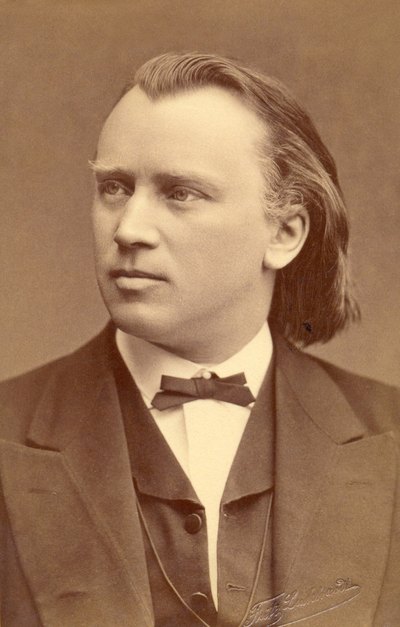 The composer of this pieceJohannes Brahms1833–1897 · born in Hamburg, Germany
About this piece
The winds ring out three chords with force, and above them the violins pour down like a waterfall. That is how Brahms's Third Symphony begins, in a single breath.
At a glance
- What it isthe first movement of Symphony No. 3, marked Allegro con brio, fast and spirited.
- Who, when, whywritten in the summer of 1883 by the fifty-year-old Brahms in Wiesbaden. It was first performed that December in Vienna under Hans Richter.
- What to listen forthe three-note motto at the start, and the moments where major and minor collide.
Listen for
- Three notesthe winds sound F, A-flat, F with force. These three notes reappear throughout the movement, hidden in the bass and in the melodies.
- Major and minorthe piece is in F major, but the second note carries a minor color, so light and dark collide. That tension drives the movement to the end.
- The second themethe clarinet brings out a gently swaying melody, a breathing space in contrast to the bold opening.
When it was written
Brahms hesitated for nearly twenty years before releasing his First Symphony, but after that he wrote symphonies relatively quickly. The Third came six years after the Second. He spent summers in scenic places writing large works, and the summer of 1883 he spent in Wiesbaden on the Rhine.
There is a story that the opening three notes are connected with the initials of 'free but happy', a motto Brahms is said to have taken as a young man. The Third is the shortest of Brahms's symphonies, and unusually all four of its movements end quietly.
A question to think about
Brahms never married and lived alone all his life, and he is said to have taken 'free but happy' as his motto. Perhaps he added the 'but' because he knew freedom and happiness do not always arrive together.
Is living freely the same as living happily? If something must be given up to gain freedom, what is it, and is it worth the price?