
VOL. 01 · Track 6 · 6 / 15
Symphony No. 5 · I. Allegro con brio
The opening movement of a symphony driven entirely by a four-note motif: three short notes and one long.
 VOL. 01
 Your First Music Journey처음 떠나는 음악 여행
This track plays with a membership. Tracks 1 and 2 are open to everyone.About membership
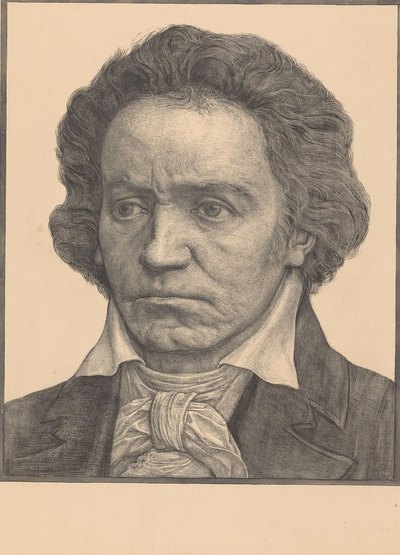 The composer of this pieceLudwig van Beethoven1770–1827 · born in Bonn, Germany
About this piece
Da-da-da-dum. These four notes are less a theme than a seed. From this one small seed Beethoven grew an entire movement.
At a glance
- What it isthe first movement, Allegro con brio (fast, with vigor), of a four-movement symphony in C minor.
- Who, when, whyBeethoven wrote it over several years and premiered it in Vienna in December 1808 at a long concert devoted entirely to his own works.
- What to listen forthe four-note motif piling up as it passes between instruments, the second theme opened by the horns, and the oboe's brief soliloquy.
Listen for
- The openingthe full orchestra strikes the four notes twice, then the motif chases its way between the string sections.
- The second themethe horns call out with the four-note rhythm, and the violins answer with a gentler melody. Underneath, the rhythm keeps hiding.
- The oboe in the recapitulation: as the main theme returns, the oboe pauses for a short, slow solo, a brief breath in the storm.
When it was written
When he was writing this symphony, Beethoven was in his mid-thirties and, despite worsening hearing, produced large works one after another: the "Eroica" Symphony, the Fourth Piano Concerto, the Violin Concerto. The Fifth was written at almost the same time as the Sixth, the "Pastoral," and the two were premiered at the same concert.
The premiere was one item in a concert of more than four hours in a cold theater, with too little rehearsal. But in 1810 the writer E. T. A. Hoffmann praised the work in a long review, and its fame began to spread. The nickname "Fate" comes from unreliable testimony and is rarely used in English- or German-speaking countries.
A question to think about
This movement builds a vast structure by stubbornly repeating and transforming one tiny motif: small things piling into great force. Social change, too, often begins with many people's small actions adding up.
For small individual actions to add up to social change, what is needed so they don't scatter but carry on?